Monday, October 12, 2026 | St. Lawrence County, NY

Everyone is arguing about whether AI is killing SaaS. ZoomInfo looked at 229 software categories across its database and found that small companies are dropping point solutions at four times last year's rate. At the recent Salesforce Dreamforce conference, companies discussed what they are doing about it.
Roughly $2 trillion of software company value has moved this year on the claim that AI is killing business software.
On the one hand, Salesforce announced that nine of the ten biggest AI companies use Salesforce and Slack, and their spending is up 435% in a year.
Compare that to what's filled the feeds for most of 2026: stories like the 55-person firm that ditched its CRM, built its own, and saved about $100,000 a year seemed to crop up every other day.
Both sides have valid examples. Here’s what the macro view looks like.
ZoomInfo tracks the software that companies use across 229 categories and every company size, from firms with less than 10 staff through to global enterprises.
In looking at every tool added or dropped over two years, from mid-2024 to mid-2026, ZoomInfo saw an interesting trend when categorizing software into two groupings:
Point solutions: Software that does one job, with fewer dependencies. Live chat, help desk, web forms, marketing automation, review management.
Systems of record: Software that holds the data the rest of the business runs on. CRM, HR, payroll, accounting, ERP, reporting.
The data showed a serious gap emerging between the two software types, but only at one end of the market.
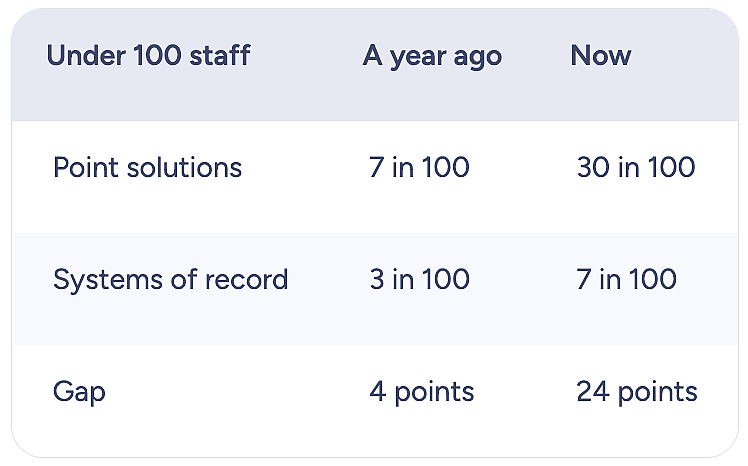
A year ago, at companies with under 100 staff, point solutions and systems of record were being dropped at close to the same rate.
Now, in the space of only one year, point solutions are being dropped four times as often as they were, and the gap between point solutions and systems of record is 24 percentage points.
Adds are flat across the group, so the number of buyers hasn't changed. Live chat went from 1,700 drops a quarter to 9,900; help desk went from 700 to 7,200; marketing automation went from 900 to 9,300.
Why? A point solution is the kind of thing a small team can now look to replace in an afternoon. Someone builds a workaround with an AI tool and switches the old one off. These point solutions have no data of their own. What they have is a workflow, which is now a lot easier to replace.
At the smallest companies, a third of all activity on point solutions is now companies dropping them. A year ago it was under one in ten.
Then it falls at every step up in company size. It halves at 50 staff. It halves again at 1,000. Over 10,000 staff, it's 1 in 100, exactly where it was a year ago.
At large companies, the gap between the two kinds of software opened by just two points.
What's left to be seen is how much this is going to change. There are two ways to read it. Either large businesses will keep these tools because they are harder to remove once everything is wired into them, or large businesses just move more slowly and the same trend reaches them over the next few months.
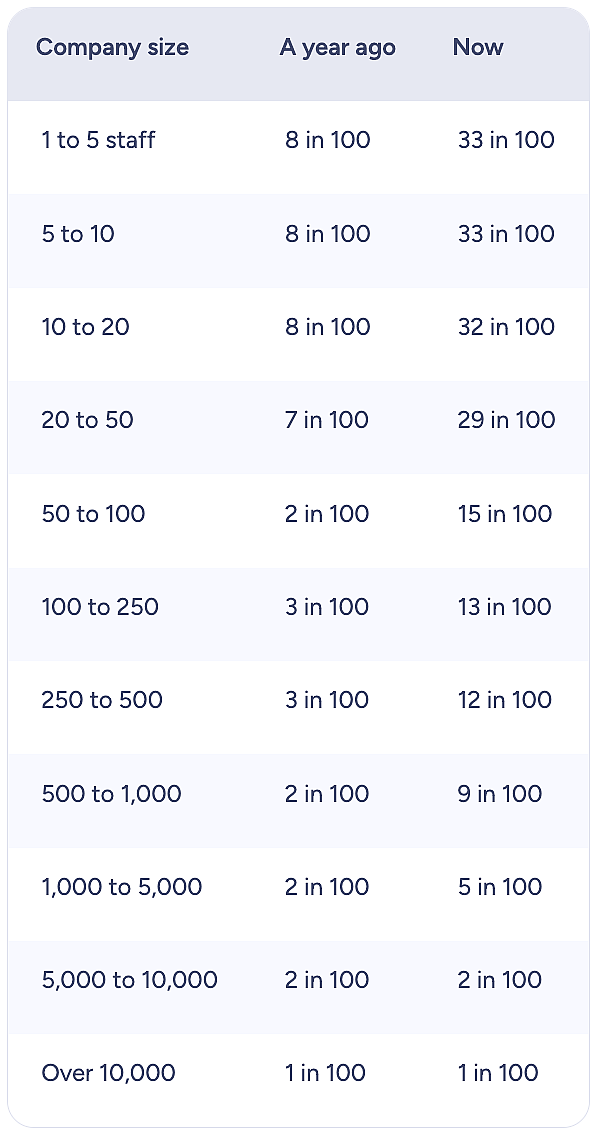
Table shows, for all activity on a software (adds and drops), how many were drops. Broken down by company size.
The discussion on the Dreamforce floor lined up almost exactly with the numbers above.
Everything at Dreamforce came down to where the data lives and where people go to use it, which splits the market three ways. The systems of record, who hold the data. The front end, which increasingly means Claude and ChatGPT, where people now go to get things done. And the orchestrators, who move work between the two.
A point solution is none of these. It's an app with a workflow in it, and it relies on people opening the app.
That explains the numbers we're seeing. People go to Claude or ChatGPT instead of multiple apps. The system of record took the workflow: it already had the data, and now it's building agents on top of that. And anything left over, a small team can rebuild in an afternoon. A point solution held no data and did nothing the other three can't. So it gets switched off.
Looking around the booths at Dreamforce, almost every one had an agent, and most of them were an AI wrapper on what the product already did. The ones without a system of record underneath were quiet, because their agent did nothing Claude or ChatGPT couldn't.
So what are companies doing about it? On the floor, the answer was the same everywhere: they overbought, and now they are consolidating around the systems that hold their data, with an agent doing the work that used to need a separate tool.
A year ago, point solutions and systems of record were being dropped at nearly the same rate. Now they're 24 points apart.
The SaaSpocalypse is real for point solutions at small companies. It isn't happening to large companies yet, and it isn't happening to systems of record.
In Q1, the build hype was real. People were saying no SaaS tool was safe. That has calmed down, and what's left are two questions every buyer is asking:
A lot of tools don't have a good answer to either.
This story was produced by ZoomInfo and reviewed and distributed by Stacker.